Auto dealership security and life safety systems.
A dealership stores several million dollars of inventory outdoors, unattended, every night — and concentrates every key to it in one room. Then the service bay adds a completely different hazard profile behind the same building.
What a dealership needs
- Lot coverage that identifies rather than observes plate and face capture at the entrances, not a wide shot of the whole lot.
- Key storage protection the highest-value, lowest-effort target on the property.
- Service bay and parts department access control areas with their own inventory problem and their own hours.
- Perimeter and after-hours intrusion detection showroom glass, service doors, and the parts room.
- Night lighting integrated with camera design outdoor footage is only as good as what the camera can see at 2am.
- Fire alarm in service and paint areas process hazards that differ from the showroom and office.
- Customer and staff area separation showroom open, back-of-house controlled, without a key for every door.
What gets tested, and how often.
A dealership is really three occupancies sharing a parcel — retail showroom, office, and a repair garage with its own hazards.
| Item | Interval | Reference | Why it matters here |
|---|---|---|---|
| Fire alarm system | Annual | NFPA 72 | Service and paint areas carry detection requirements the showroom does not. |
| Fire extinguishers | Annual · 6-year · 12-year | NFPA 10 | Service bays need extinguisher classes and placement suited to flammable liquids, not office-grade units. |
| Emergency & exit lighting | Monthly · Annual 90-minute | NFPA 101 | Service areas and parts storage are frequently the least-lit parts of the building during an outage. |
| Kitchen hood suppression | Every 6 months | NFPA 96 / 17A | Applies only where a customer café or staff kitchen has commercial cooking equipment. |
The lot is where the loss happens, and where the cameras usually are not.
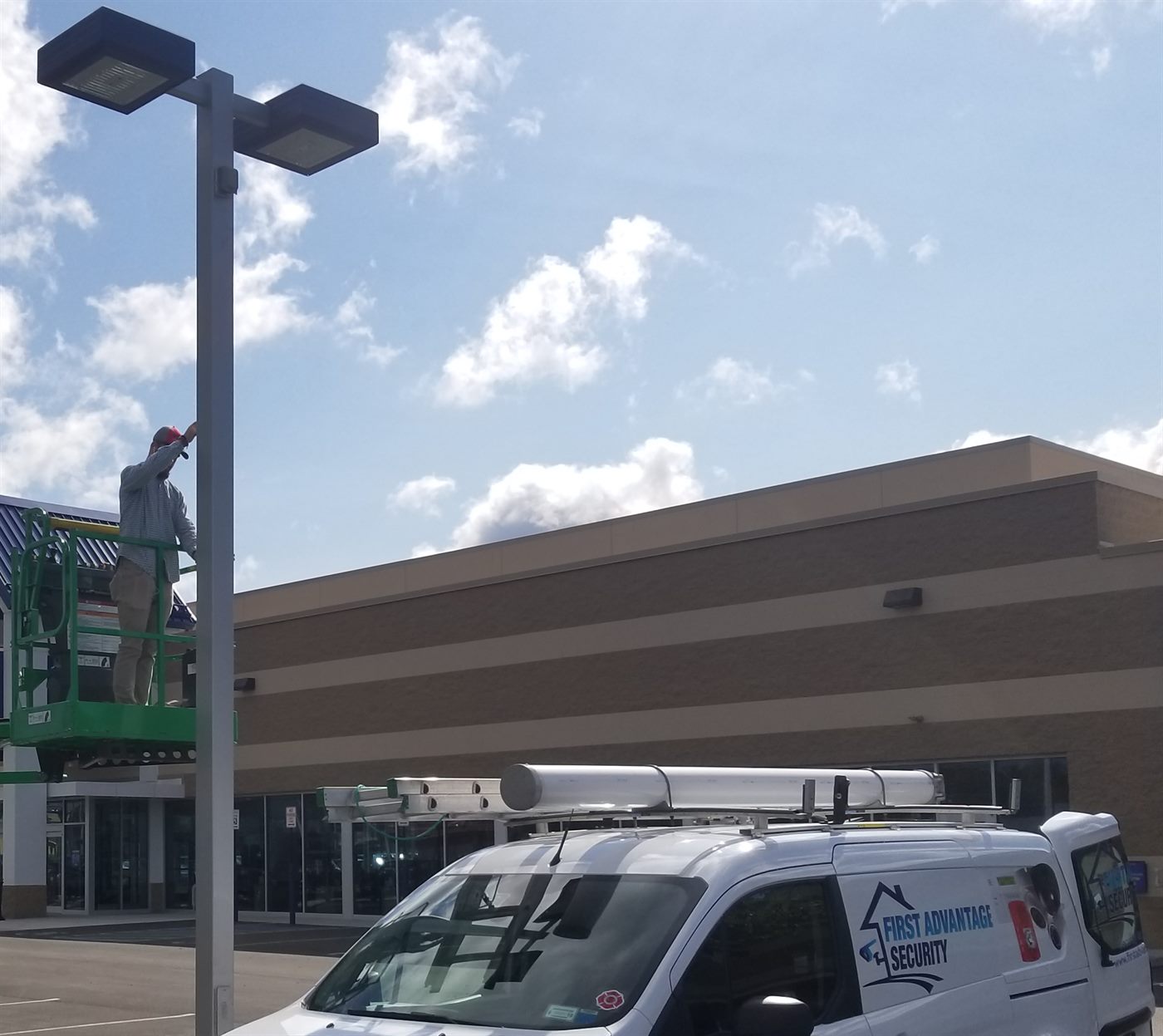
Showroom coverage is rarely the problem. The gap is the lot — rows of vehicles at night, catalytic converters and wheels going missing, and footage that proves somebody was there without ever establishing who.
Light poles solve most of it. They already stand where the sightlines are, they already have power, and a camera at that height covers plate-readable angles that a building-mounted unit at the storefront simply cannot reach across a full lot.
What a dealership project usually looks like.
Usually it starts with the lot — either a theft or a near miss — and the review finds the existing cameras produce footage that shows a person was present but cannot establish who. Fixing that is a placement and lens problem more than a camera problem, and it typically expands into key control and service bay access once someone has walked the property properly.
Two dealerships we look after make the point. At the Chrysler Dodge Jeep store in Clifton Park and at Greenwich Ford in Greenwich, we handle the security alarm, the cameras, and the network cabling and low-voltage infrastructure underneath both.
That combination matters more at a dealership than most building types. Camera coverage across a lot is only as good as the cable and the network carrying it, and when those belong to a different contractor, a fault becomes an argument about whose fault it is rather than a repair. One contractor for the cameras and the cabling means one phone call.
What we install and inspect in these buildings.
Questions from this building type.
Can cameras cover the whole lot?
They can, but coverage and identification are different goals. A camera that shows the whole lot shows you that something happened; a camera at the entrance, positioned for plates and faces, shows you who.
A good design uses both, and it takes fewer cameras than most quotes assume.
How do we protect the key room?
Access control on the door with logged entries, camera coverage inside, and intrusion detection that covers the room specifically rather than relying on the building perimeter. It is the single highest-value target on the property and worth treating that way.
Does the service bay need different fire protection?
Generally yes — flammable liquids, welding, and vehicle storage create hazards the showroom does not have, which affects both detection and extinguisher classification. Your AHJ will look at these areas differently, and so do we.
Request a site survey
We walk your building, document what you have, identify what is missing or coming due, and give you one written plan for the whole property. It takes about 45 minutes and costs nothing.
-
We call within one business day
To find a time that works around your operations, not ours.
-
A technician walks the property with you
Bring whatever documentation you have, or none at all. We document what is installed, what is missing, and what is coming due.
-
You receive a written plan and price
One plan for the whole property, phased across budget years if that is what the building needs.
-
Nothing else happens unless you say so
We do not chase. If the timing is wrong, tell us when to check back.